
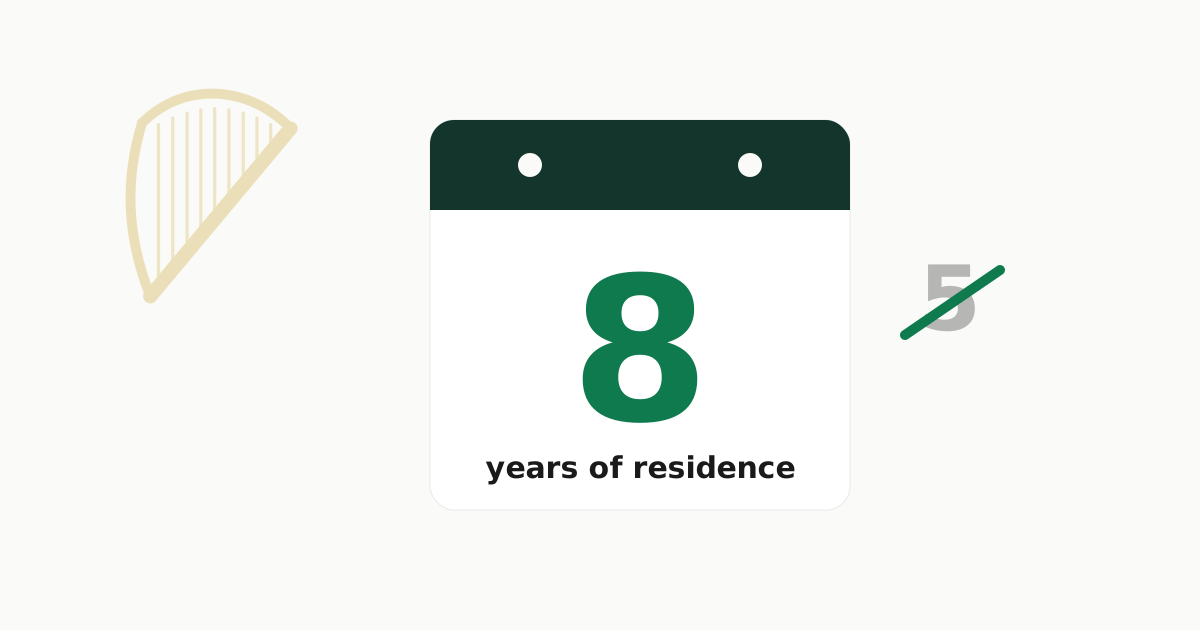
The rule today
Five years of reckonable residence within the last nine, including one continuous year immediately before the application date. “Reckonable” is doing real work in that sentence: time without permission to remain doesn't count, and neither — for most people — does time as an asylum applicant or on a student permission. Refugees and international protection holders need five years, raised from three in late 2025.
The proposed rule
Eight years of reckonable residence, structured as two years of continuous residence immediately before applying plus six years within the previous ten. Spouses of Irish citizens would need five years of marriage or civil partnership and five years of residence (two continuous, three of the last five). And a new exclusion: time spent in Ireland under the Temporary Protection Directive would not count at all.
Who it catches
- Anyone between five and eight years in. This is the squeezed group: eligible today, not eligible under the bill. Depending on transitional rules and commencement timing, they either file in time or wait up to three more years.
- Ukrainians under temporary protection. The Taoiseach has said temporary protection “was never meant to be a pathway to citizenship”. For someone who arrived in March 2022 and stayed on temporary protection throughout, the citizenship clock hasn't started — and under the bill it never will until they hold a different permission.
- Spouses married three to five years. Eligible under the current three-year marriage rule, not under the proposed five.
- Recent arrivals. Anyone arriving now should simply plan around eight years: arrive in 2026, apply no earlier than 2034 under the new arithmetic.
Who it doesn't touch
- Citizenship by descent. An Irish parent or grandparent (via the Foreign Births Register) is a different legal route entirely — no residence, no test.
- People already naturalised. The changes are forward-looking; existing citizens are unaffected (the separate revocation provisions concern public order and national security cases).
- Most likely, pending applications — though this is the part the bill hasn't confirmed. Past reforms have applied new rules to new applications, but until the transitional provisions are published, treat this as probable rather than certain.
Why eight?
The Government's argument is alignment and integration: several EU states require eight to ten years (Italy and Spain's general rule is ten; Germany recently moved the other way, down to five), and ministers argue a longer period ensures citizenship reflects a settled life rather than elapsed time. Critics, including migrant-rights groups, counter that Ireland is jumping from the EU's liberal end to its strict end in a single move, and doing it while a backlog of roughly 61,000 applications is still being processed.
The practical arithmetic
- Count your reckonable residence today, precisely — permission stamps, letters, the official online calculator.
- If you're at five or more years (three as a spouse or refugee under current rules): the file-now question is urgent for you.
- If you're at three or four years: the race is between your clock and the bill's commencement. Keep permissions continuous — a gap now is fatal to the continuous-residence requirement either way.
- If you're on temporary protection: explore whether you can move to another permission; under the bill, that's the only way the clock starts.